
THE WOMAN WHO SOLD BRITAIN THE AIRSHIP AGE
Lady Sybil Grant and the Making of Airship-Minded Britain
Among the engineers, naval officers, and aviators who shaped Britain’s airship programme during the Great War, one figure stands apart with unusual vividness: Lady Sybil Grant. Aristocrat, poet, photographer, filmmaker, journalist, and relentless advocate for lighter-than-air flight, Lady Sybil occupied a unique position within Britain’s wartime and post-wartime aviation culture. Though never a conventional military officer, she became deeply associated with the Royal Naval Air Service and later the emerging air-minded world that followed the creation of the RAF. In many respects, she helped Britain imagine the airship age.
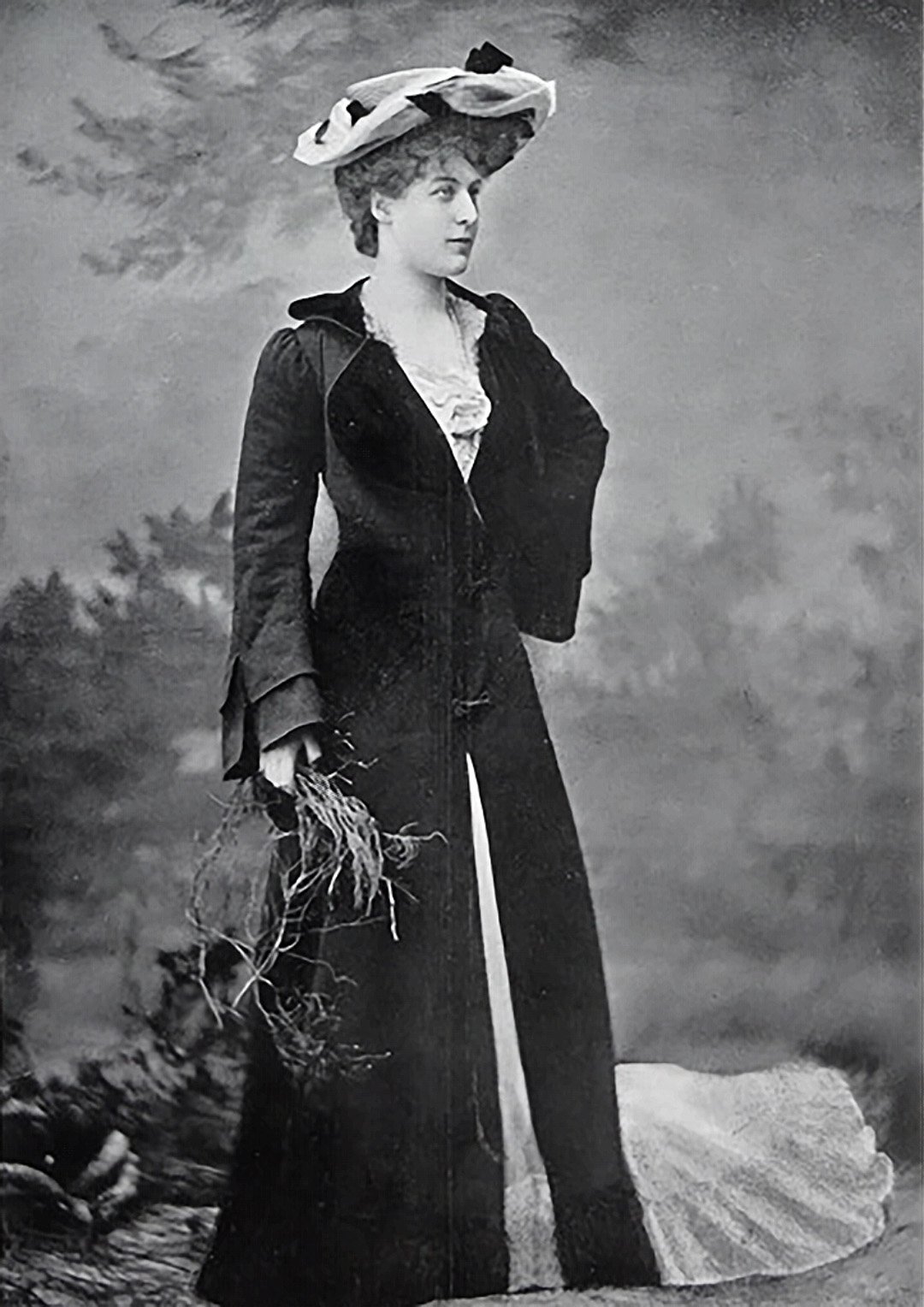
Lady Sybil Grant. Country Life, 4 April 1903
THE ARISTOCRATIC REBEL
Lord Rosebery belonged to a generation obsessed with Britain’s imperial communications network — railways, steamships, telegraphy, naval supremacy, global movement. Airships later emerged as a continuation of exactly that mindset: the dream of binding the Empire together through advanced aerial transport. In a sense, Sybil seems to have taken her father’s late-Victorian imperial imagination and translated it into the aerial age. There may also be a subtler psychological dimension. Rosebery was famously brilliant, restless, romantic, melancholic, and somewhat theatrical as a public figure – qualities that oddly echo the emotional tone of the British airship movement itself. The airship world attracted dreamers as much as engineers.
Lady Sybil cultivated the reputation of a determined nonconformist. At a time when aviation itself still seemed fantastical to much of the public, she immersed herself in one of its most futuristic branches: the military airship. While many society women of the Edwardian era participated in charitable wartime work, Lady Sybil moved far beyond conventional expectations. She entered military aviation environments, documented airship operations through photography and cinematography, wrote newspaper columns and poetry about flight, and organised exhibitions devoted to aerial technology.
Her fascination was not merely technical. She saw airships as symbols of modernity – expressions of national ambition, scientific progress, and a new relationship between Britain and the skies. She was “air-minded” – a term much used at the start of the 20th century – and, specifically, very much airship-minded.
At 23 years old Sybil married into the famous Grant whiskey family by marrying General Sir Charles John Cecil Grant, KCB, KCVO, DSO, (1877-1950), at the Guards Chapel.
Do not search for a genuinely clever woman. It is not wise to look for trouble.
Lady Sybil Grant
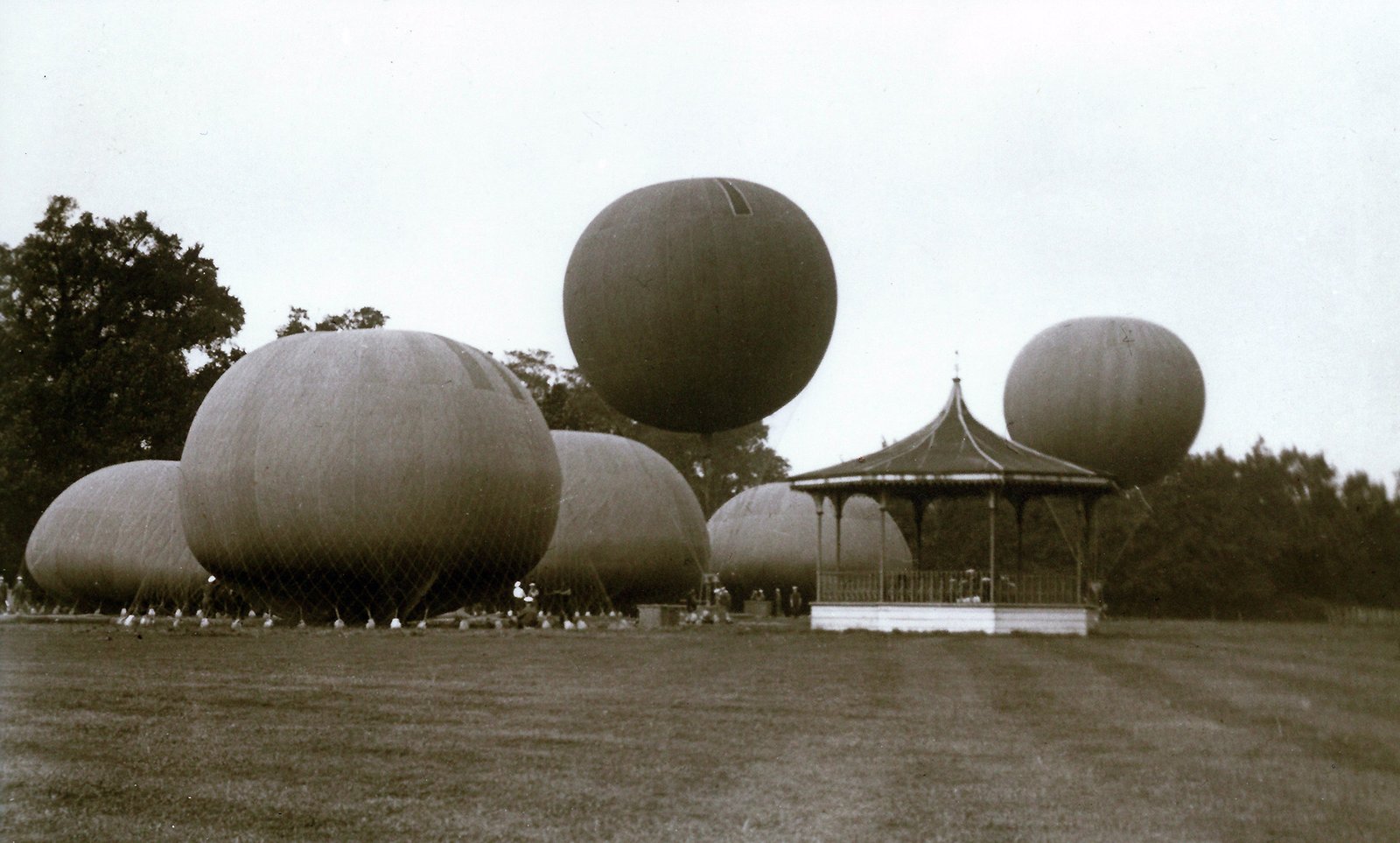
Kite balloon training at Roehampoton where her family lived at Primrose House. Image: NS11.org
LADY SYBIL & THE ROYAL NAVAL AIR SERVICE
Although the exact nature of Lady Sybil Grant’s formal relationship with the Royal Naval Air Service remains somewhat elusive (an area we are still researching), surviving evidence makes clear that she enjoyed unusual access to wartime aviation activity. From the Calgary Daily Herald, 10 May 1917:
LADY SYBIL GRANT SERVING IN THE AIR
Lady Sybil Grant, the very versatile daughter of Lord Rosebery, has for some time been acting as official photographer to the Royal Naval Air Service corp at Roehampton, thus adding to her accomplishments.
A familiar figure on the flying ground at Roehampton, she makes ascents in the kite balloons several times a week, and her photographic proficiency enables her to obtain photographic records from the air which are said to compare favorably with those secured by male photographic recorders. Lady Sybil has been known for quite a considerable time as an amateur photographer of merit, and as she combines this facility with much courage she was induced to proffer her services to the R.N.A.S.
That she does her flying at Roehampton is explained by the fact that her residence, Primrose Lodge, now turned into a hospital, is almost opposite the flying grounds.
Usually when making an ascent Lady Sybil wears a cap marked by her father’s racing colours – primrose and rose hoops. The flying men at Roehampton speak of her as absolutely fearless are unassuming. Seeing how successful the experiment of utilizing the services of a woman aerial photographer has been in her case, it ought to be possible to extend it to other women, and thus release more men for other work.
During the Great War she photographed and filmed RNAS and RAF subjects, including airships, aerodromes, workshops, personnel, and training activities. Surviving footage associated with her work reveals a remarkable visual record of Britain’s wartime aviation world – not merely airships themselves, but the human infrastructure surrounding and supporting them.
The Liverpool Echo of 1 September 1922 reported…
She served the Admiralty as official photographer to R.N. stations at Roehampton and Wormwood Scrubbs all through the war. In 1915 she applied to the Admiralty for instruction in cinema operating, and personally took the official film of every airship trial from the famous “Number Nine,” at Barrow-in-Furness until the Armistice.
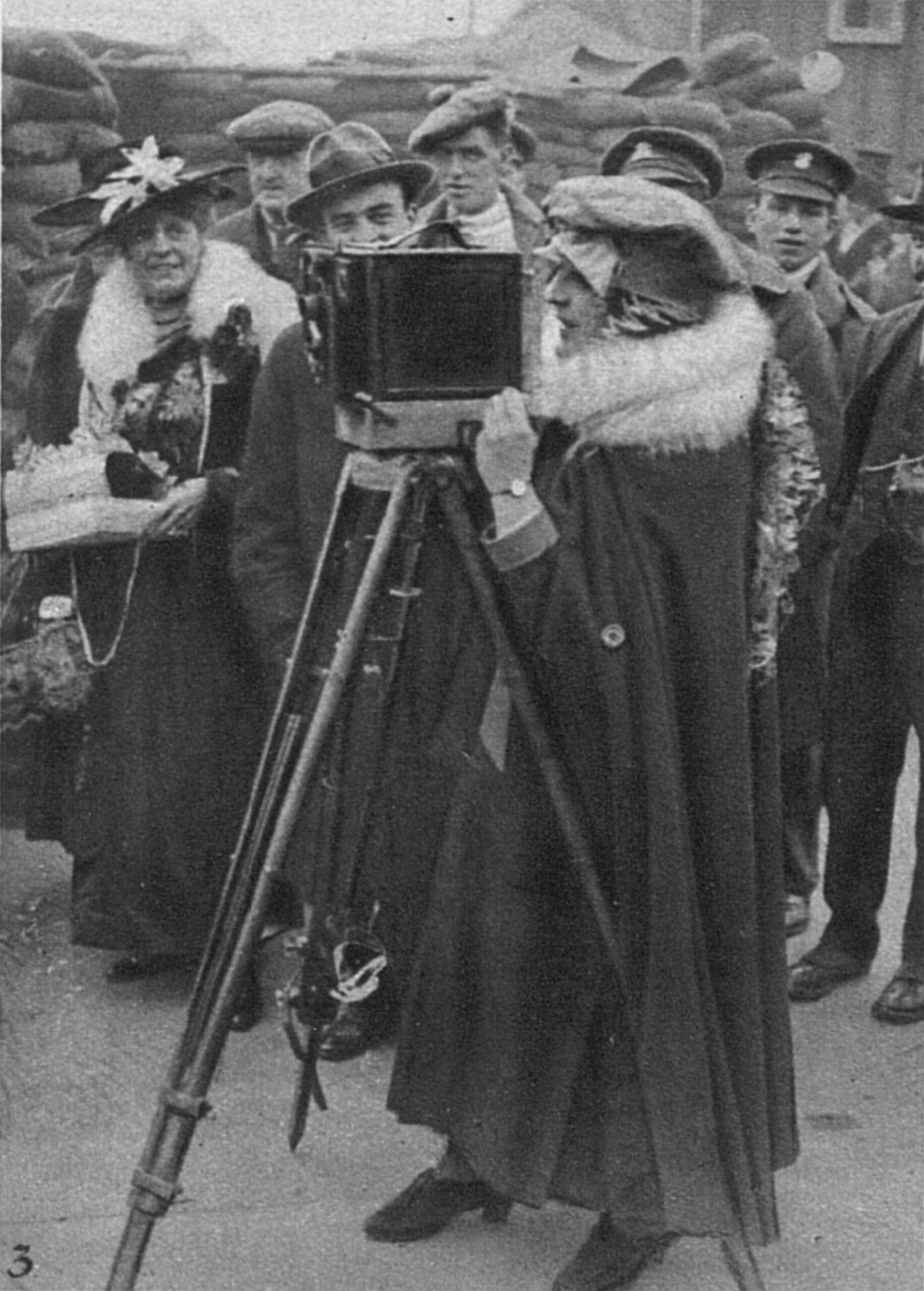
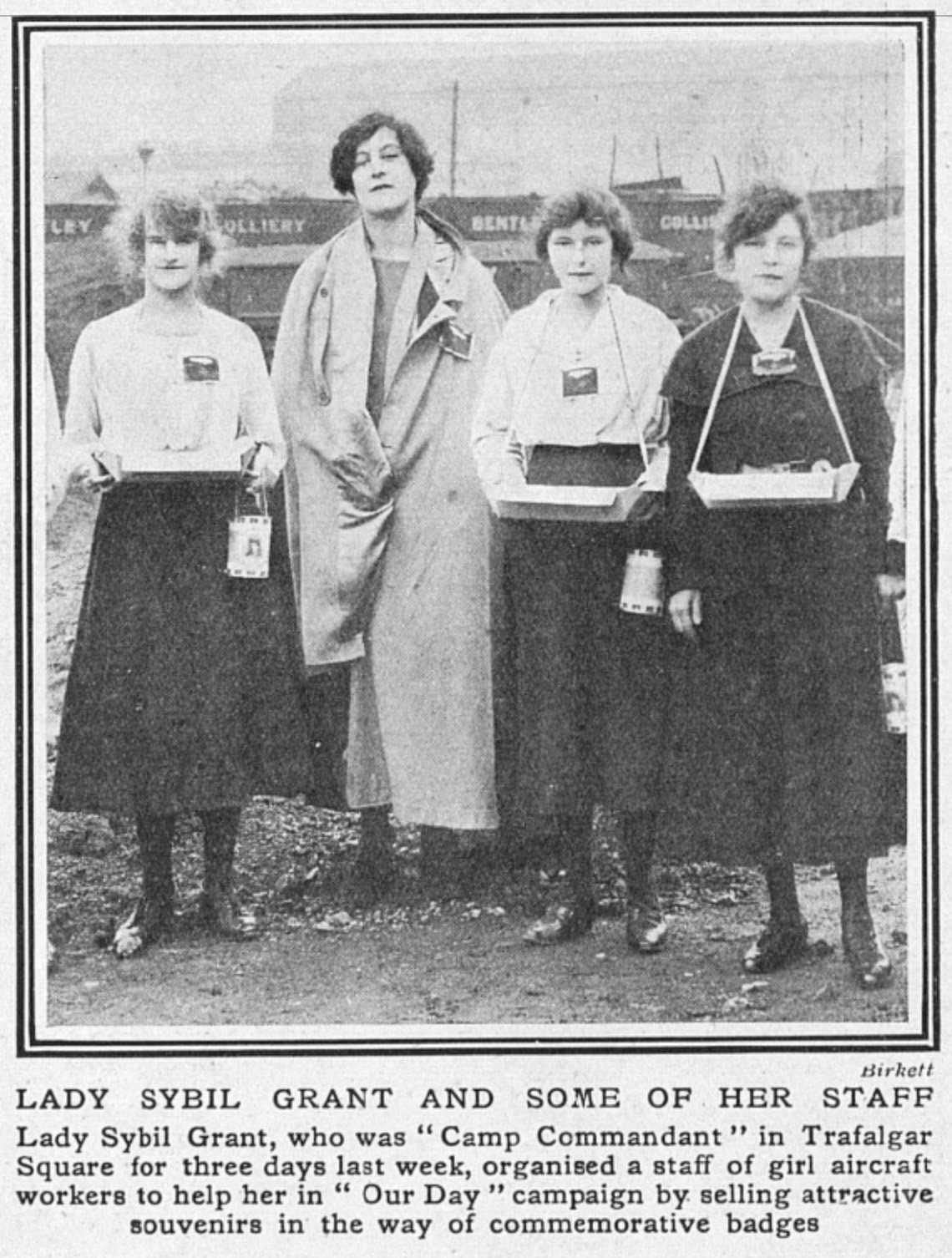
Lady Sybil operating a “bioscope’ at Trafalgar Squre during the “Our Day of Victory” event from The Sketch, 30 October 1918. She mastermined the event which included a camoflage fair, recreations of the trenches and a shattered village at the Western front and involvement of WRAFs, and girls from airship constructors Spencers; Armstrong; and Beardmore. There was to be a ‘hut’ at the ‘Sign of the Airship’, superintended by Lady Sybil Grant, and a ‘continuous cinema’ to show ‘interesting films, including the Red Cross film, “From No Man’s Land to Blighty”. Image: British Newspaper Archive
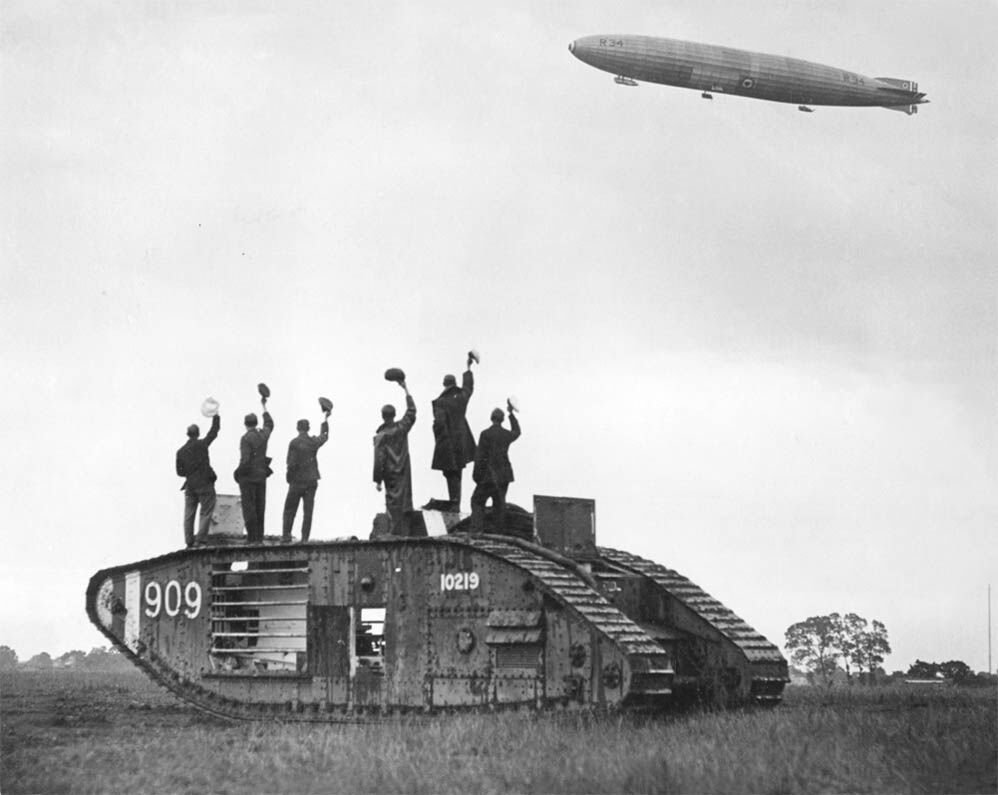
R34 arriving at Pulham following her double-crossing of the Atlantic. Image: Wikimedia Commons
Her work also documented airship sheds, ground crews handling lighter-than-air craft, mechanics and workshops, women employed in wartime aviation, training, and daily operational life. Watch an example of one of Lady Sybil’s films hosted by the BFI here.
Working so closely with the airship service afforded Sybil with insight as well as access. Following R.34’s triumphant return from its double-crossing of the Atlantic, from the Glasgow Herald of 15 July 1919 (the day N.S.11 was lost) she wrote:
R 34’s triumphant return had only one drawback – that the Scottish airship landed at Pulham. This was not her fault, for both her own condition and that of the weather proved satisfactory on Saturday night, but it was necessary in view of an event arousing such public interest, that in the final arrangements should be made well in advance, and certainly early on Saturday morning the weather reports at Pulham were more promising…. …We cannot lay too much stress on the fact that although R 34 carried with her all the good wishes and hopes of the airship supporters these were hopes founded on a firm foundation and that this exploit is by no means viewed as a supreme achievement. That the number of those interested in airships was then not so large as it is to-day cannot be called the fault of airships, the blame lying rather with circumstances. in the past profound and sometimes excessive secrecy shrouded the subject. It is to break the silence of two worlds that R 34 crossed the sea bering her proud motto – pro patria volans.
On 7 October 1919 at Buckingham Palace, Lady Sybil presented to the Queen Miss Lizzie Chestnut a worker from the airship shed at Inchinnan, where she was employed on the construction of R34. They presented to the Queen a replica of the figurehead of R34 in the form of an aluminium shield bearing the Lion of Scotland and the airship’s motto mounted on mahogany.
At a moment when military aviation was still new and mysterious to the public, Lady Sybil helped translate this hidden world into something visible and emotionally compelling. This role was highly unusual for a woman in wartime Britain. Though women contributed extensively to the war effort, few operated so close to the technological and military frontier of aviation culture.
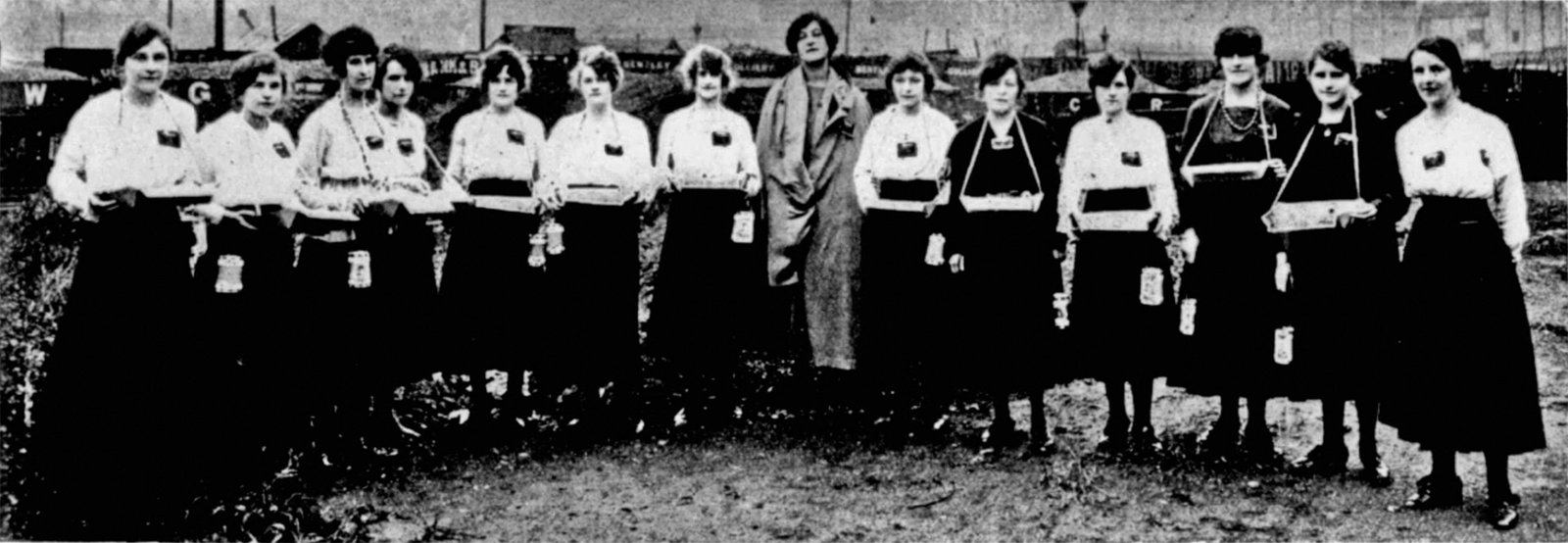
Lady Sybil Grant and her airship workers at Trafalgar Square, from The Ladies Field, 2 November 1918. Image: British Newspaper Archives
SELLING THE ROMANCE OF FLIGHT
Lady Sybil Grant did not simply document airships. She promoted them. Through articles, lectures, exhibitions, poetry, photography, and public appearances, she became one of the most enthusiastic cultural advocates for lighter-than-air flight in Britain.
The engineers and crews of the RNAS and RAF built and operated the airships, but figures like Lady Sybil helped create the wider public mythology surrounding them. Airships possessed a peculiar power over the imagination during the early twentieth century. Unlike aeroplanes, which were noisy, fast, and often fragile, airships seemed almost dreamlike – giant silver vessels floating silently above fields, coastlines, and cities. They represented not merely military machines, but the future itself.
Lady Sybil understood this instinctively. Her writing and public work framed airships not simply as weapons of war, but as symbols of possibility. She championed the idea that aerial navigation might transform communication, travel, and even civilisation. In this sense she became part propagandist, part artist, and part futurist.
In her book of poetry The End of the Day, published in 1922, five of her poems were written about airships: The Trial Flight (R24); Pro Patria Volans (R34); Dropping the Trail (R36); The Dream Patrol (N.S.1); and Above the Clouds (R33).
DROPPING THE TRAIL
TO H.M.A. R.36
“Stand by to drop the Trail” – home from the skies
The grave wind chanties, and the musing stars
Back to encounter turmoil, smoke, and wars:
A poor exchange for Heaven’s high harmonies!
All night the ship has flown: serene and wise
Upon an even keel; against her cars
Rain beat-as restless fingers fret guitars:
Lightly and without heed. Fair paradise
Of moon clouds followed in our wake – Content
Encompassing us: sweet, unearthly, sure,
Alive as any presence; it seems plain
To those whose duties lie on high is sent
This gift: born of the clouds radiant and pure.
Stay with us till we seek the stars again.
Lady Sybil Grant
from her book of poetry The End of the Day
AIRSHIPS, ART AND IMAGINATION
What makes Lady Sybil especially unusual is that she approached aviation not only as a technological phenomenon, but as an artistic and emotional one. Where engineers discussed lift, gas volume, and engines, Sybil often seemed more interested in what airships meant psychologically and culturally.
In many ways she belongs to a small group of early twentieth-century cultural figures who treated flight as a source of imagination, symbolism, and aesthetic experience. This places her in the company of other women associated with Britain’s airship world, including Lady Drogeda (Kathleen Pelham Burn) and Pansy Chambers¹ – another poet and aviation enthusiast and one deeply connected to N.S.11 and featured on this site. Both women appear to have recognised something emotionally powerful in the airship age. Their writings suggest that they viewed flight not simply as transport or warfare, but as transformation. This imaginative dimension is often absent from conventional aviation history, which tends to focus on engineering achievements, military operations, or disasters. Yet during the Great War and the interwar years, airships inspired artists, writers, photographers, and dreamers as much as they did naval strategists. Lady Sybil Grant helped shape this cultural atmosphere around airships much as, later in 1929, the journalist Lady Drummond-Hay did aboard the Graf Zeppelin during it’s circumnavigation of the world.
For many people born in the Victorian world, the appearance of aircraft and airships seemed to collapse the boundary between science fiction and reality. Lady Sybil captured that sense of wonder. Her artistic instincts also shaped her work as a photographer and cinematographer. The surviving footage associated with her reveals an eye not merely for documentation but for composition and spectacle – enormous airship sheds, crews handling lighter-than-air craft, lines of mechanics and workers, the theatricality of aviation itself.
She appears to have understood something very modern: that aviation depended upon imagery and public imagination as much as engineering. In this respect she was remarkably ahead of her time. She functioned almost as a multimedia advocate for the airship age: writing poetry and newspaper articles; producing photographs and films; organising exhibitions; cultivating public fascination with aerial modernity – blending art, journalism, and technology.
This combination places her closer to the artistic futurist movements of the early twentieth century than to conventional aristocratic society. There is also something distinctly British in her sensibility. Unlike the aggressive machine worship of some continental futurists, Lady Sybil’s vision of flight retained a romantic quality. Her airships were not brutal industrial symbols; they were majestic, dreamlike vessels carrying Britain toward a new age.
THE TRIAL FLIGHT
To H.M.A. R.24
Rare stars were hanging like a broken chain
Flung from fantastic battlements;
Scourged and beleaguered by the bitter rain
Crouched sodden huts and tents.
Searchlights: accusing fingers, played
With darkness, now and then betrayed
The steadfast outline of the Shed.*
Now all the world is cold, and numb as lead.
Save where, against the tired, unhappy skies;
Forgotten by the twilight, clings
A slender wraith of sunset; listless dies,
Lost with forgotten things,
Unseen, slow pacing to and fro,
Whilst hours come and hours go,
And like a wave the darkness falls –
Listen: how once again the great wind calls!
The Ship is ready; in the Shed made fast,
And hurtling sleet-like hostile spears
From jealous gods-she hears not, now at last
The dawn of triumph nears,
Elusive victory would seem
To set a crown upon a dream.
Work weary, rest-it is your right;
While sentries guard your finished work to-night.
Expectant silence hangs about the place
Just now: an armed neutrality,
A sudden truce, a halt, a breathing space.
To-morrow, we shall see
The dream’s fulfilment, when the doors
Fling wide, and past the clouds she soars
(For frets of earth, and hurts, and jars
There is no home among the quiet stars).
The sounds of early night-fall now decrease,
Sleet changes to a hint of snow,
Even the wind’s low chant is hushed in peace,
The stillness seems to grow,
As if, concealed beneath a pall,
The world no longer breathed at all.
What fancies hold in magic grip
To-night the spirit of the dreaming ship?
Perhaps afar already she can see
Visions, of sleeping, shining hills,
Of life outside–of strength, and liberty,
The joy that peace distils,
Of gulls that scatter, call and wheel
Below her sweeping, lambent keel,
Of lands that bear her company
To fade away at length before the sea.
Radiance of autumn woods all gold and rust
Or, throbbing through a summer night,
Ghosts of grey cities dumb-as summer dust,
Curved harbours gay with light,
A distant gun, a syren’s croon,
Swift rivers laughing at the moon.
How feel the winter’s slow despair
Who need not notice that the trees grow bare?
And floating slow through heather-coloured skies
His heart leaps till he laughs aloud:
Who tracks-when, far below, a dark world lies –
The sun beyond the cloud.
Surely it is a perfect thing
To meet the coming of the Spring
First in the skies? Ere yet they know
The Spring is here, those earth-bound men below?
So when the hour came, and out of sight
Across the snow-wreathed hills next day,
Ready and eager for the trial flight,
She went upon her way.
The wireless whispered all went well,
But what the wireless did not tell
Was that, upon the sky patrol,
To-day another ship had found her soul.
* Inchinnan
Lady Sybil Grant from her book of poetry The End of the Day
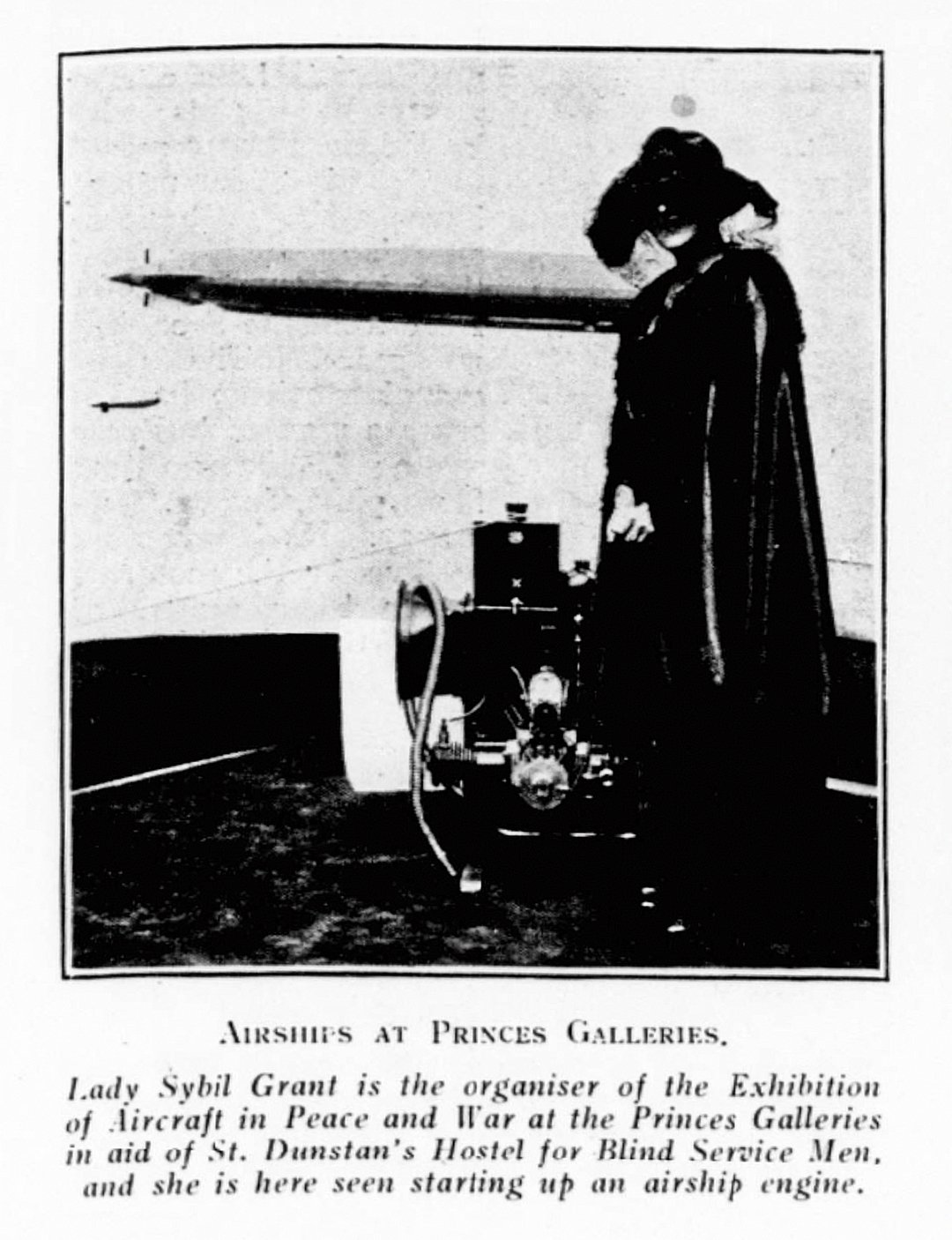
Lady Sybil Grant at the exhibition, Lady’s Pictorial, 27 September 1919. Image: British Newspaper Archive
EXHIBITION AND PUBLIC ADVOCACY
After the war, Lady Sybil continued promoting airships and aviation through exhibitions and public engagement. As organiser of the exhibition Airships in Peace and War at the Prince’s Gallery, London [possibly Prince’s Hall, Picadilly] in September and October 1919, she demonstrated both her commitment to the subject and the level of institutional support she commanded. It is known she was a very close friends of Air Commodore Edward Maitland Maitland who was a pioneer of lighter-than-air aviation. This exhibition of “a collection of very interesting exhibits”, including objects from R.34, which, with Maitland, had undertaken a double crossing of the Atlantic just two months before, was accompanied by music from the Masked Airship Band. All the proceeds went to the airship bed at St Dunstans.
Lady Sybil herself writes in the Daily Express of 4 September 1919:
Of course, every one responsible for an exhibition maintains that it bristles with original features, and I form no exception to the rule.
To begin with, an airship exhibition is original in itself, as distinct from an aircraft exhibition. When you enter you will be surrounded by airships, models, picture, sections of actual airships. Above your head, around you, everywhere, each type will be represented in every kind of material and size. You will realise just a little (for no exhibition could tell you all) of their history, of their work in the war, and last, but not least, of their place in the future.
We stand at the parting of the ways – between the ship of the air in war and the ship of the air in peace. You will see the explorer, the sentry, the liner, and the yacht: on one side an Academy picture, on the other a little sketch by a wounded French airship rating; on one hand a forty-foot framework of the old Santos Dumont, and next door the lovely little submarine scout, two feet long, made by a chief petty officer for someone he knew, who was so pleased that she married him at once.
Your breath will be taken away by the splendid exhibit sent by the French authorities and brought over in twenty-nine cases. I can say, having had the honour of working for the Airship Department of the Admiralty through the war, that every man and woman so employed looks on his or her work as a cause for which any of them gladly do their best, and with several, whose duties were less humble than mine, that best has meant giving up life itself in the cause of experiment and research. I am not counting active service casualties.
When you see the exhibits, you will realise that here all have done all they can, and that you yourself are helping too, for every penny of the profit goes to an airship bed at St. Dunstan’s.
The aim of the exhibition was to make “10,00 shillings clear of profit” – the number representing the number of in-patients and out-patients at Lady Sybil Grant’s hospital at her home at Primrose House, Roehampton.
From the Westminster Gazette of 10 September 1919:
A representative of the Westminster Gazette, who called at Primrose House, with a view to obtaining information about “Airships in War and Peace” – the exhibition that Lady Sybil Grant is holding, with the support of the Air Ministry, at Prince’s Galleries, from September 15 to October 4 – found himself surrounded by pictures and models of every shape and size; and came upon Lady Sybil and the Exhibition secretary in the throes of cataloguing.
Owning to difficulties of transport, and changing addresses, due to demobilisation, it is fully expected that exhibits will continue to arrive during the whole time that the Exhibition remains open! Our representative was particularly struck by the beautiful model of Pulham Airship Station. This will be remembered as the station where “R34” landed, after her historic flight, and we have here the whole establishment in miniature – from the gas planes to the Y.M.C.A! Pulham is also famous for mooring-out experiments – and here we have three ships moored in the open.
Primrose House still bears traces of the three year’s hospital service, and it is to former patients in the R.N.A.S. that the appeal is made for help towards the Gift Stall of the Exhibition, and which has already appeared in this paper. Our representative found exhibits everywhere, and had no idea of the number of different airships, and the uses to which the can be put. A new feature was the employment of scenic backgrounds to some of the models – with striking effect.
It must be remembered that this is the first exhibition of airships, as distinct from aircraft, and it was surprising to notice the variety of pictures collected dealing with the subject – many if them specially pained for the exhibition.
The series of water-colour sketches by P. Gattier [Pierre Gatier?], official painter to the French Admiralty, is remarkable for originality and sense of colour; this is included in the exhibits sent over by the French authorities, who have most generously contributed a complete section. The Italian and American exhibits were hopelessly held up, in spite of the most generous efforts, and to the deep regret of the respective representatives in this country; but really it was difficult to see how room could have been found for further contributions.
The armament section is very complete – and awe-inspiring, although the bombs are, of course, only dummies! The possibilities of bomb-dropping by rigid airships makes the prospect of a successful League of Nations very alluring. Every conceivable exhibit comes from those engaged in constructional work, and the instruments form a complete collection in themselves.
Altogether, our representative left feeling rather bewildered and relived to think that he had no part in the strenuous task of classification and arrangement.
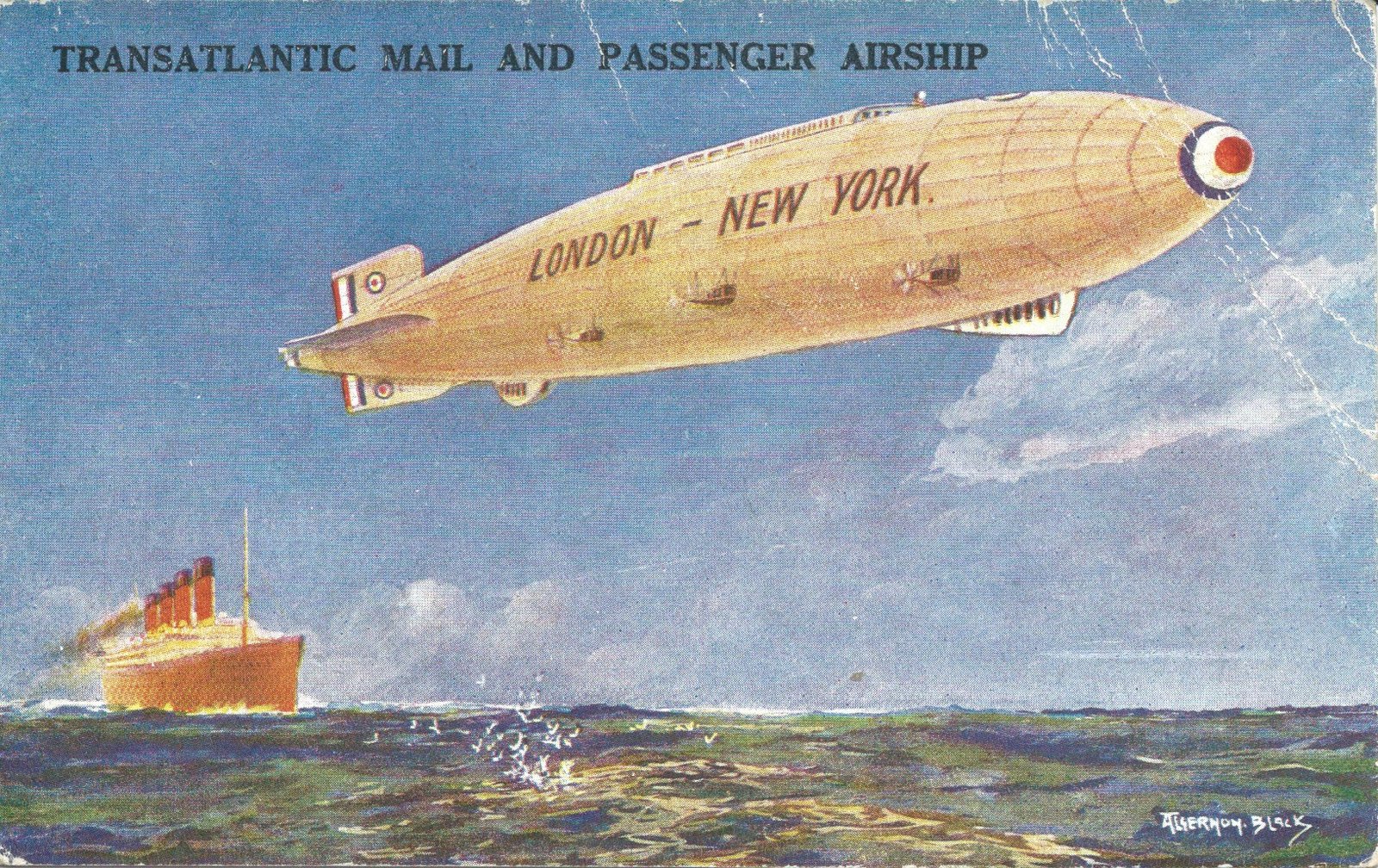
While we don’t yet have a catalogue of what was exhibited at the exhibition, we do know what artists provided work. This forward-looking illustration from a postcard of a Transatlantic Mail and Passenger Airship by Algernon Black might well have been exhibited. Image: NS11.org collection
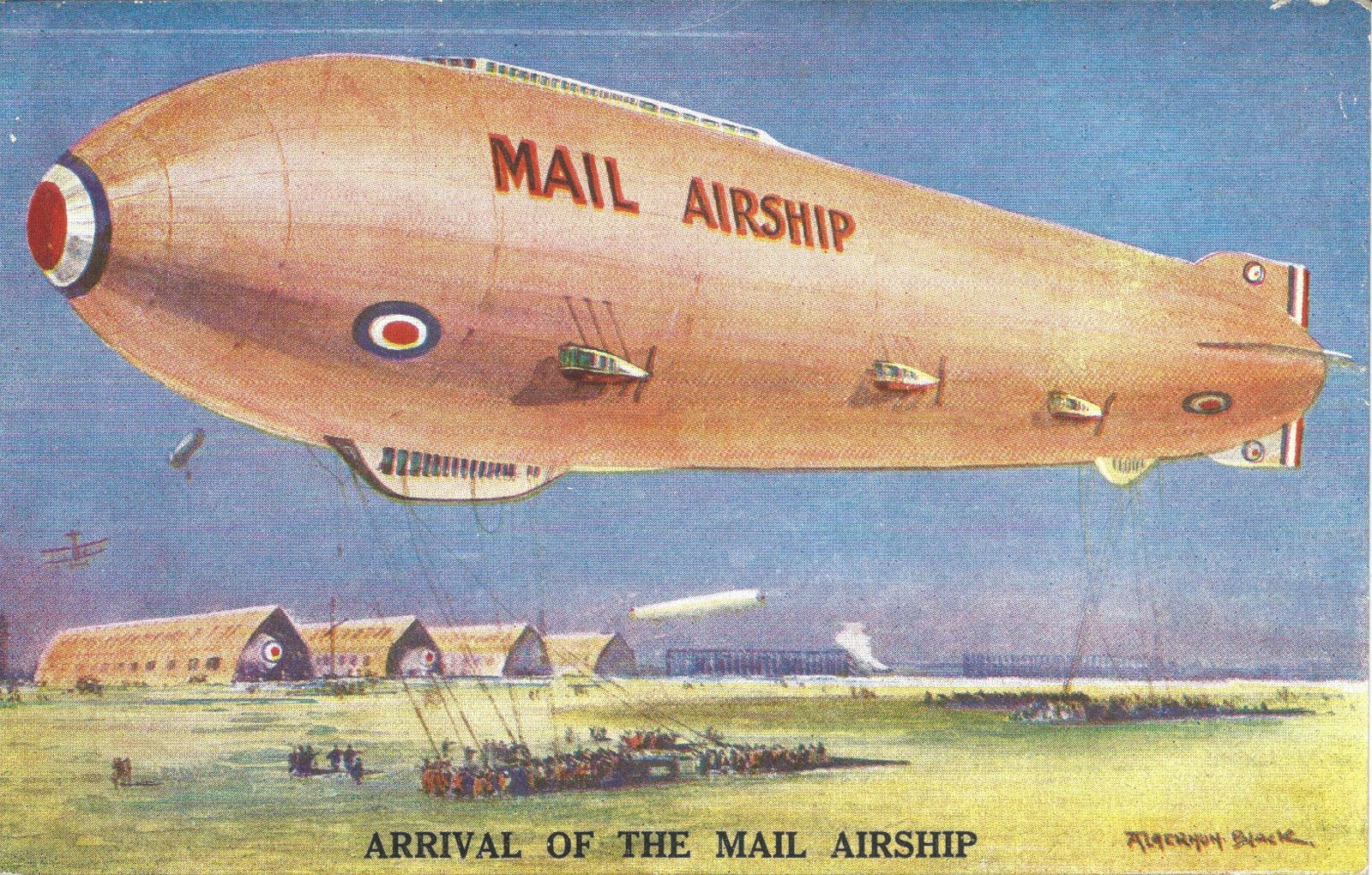
Another illustration by Algenon Black, this time of the Arrival of the Mail Airship. Image: NS11.org collection
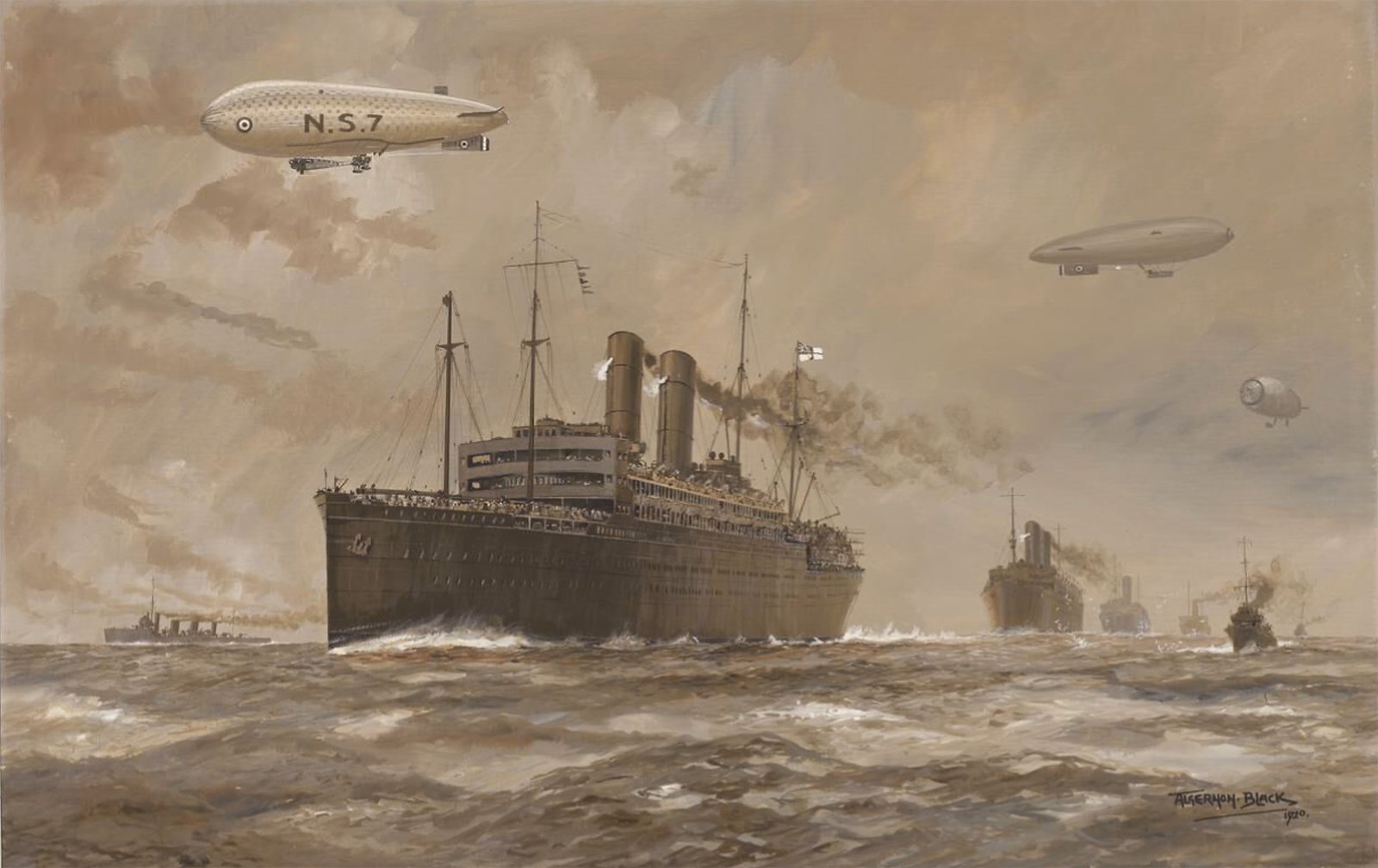
British Airships Escorting Transports again by Algernon Black. Although dated 1920 it could have appeared at the exhibition, but completed later. Image: IWM ART 3102
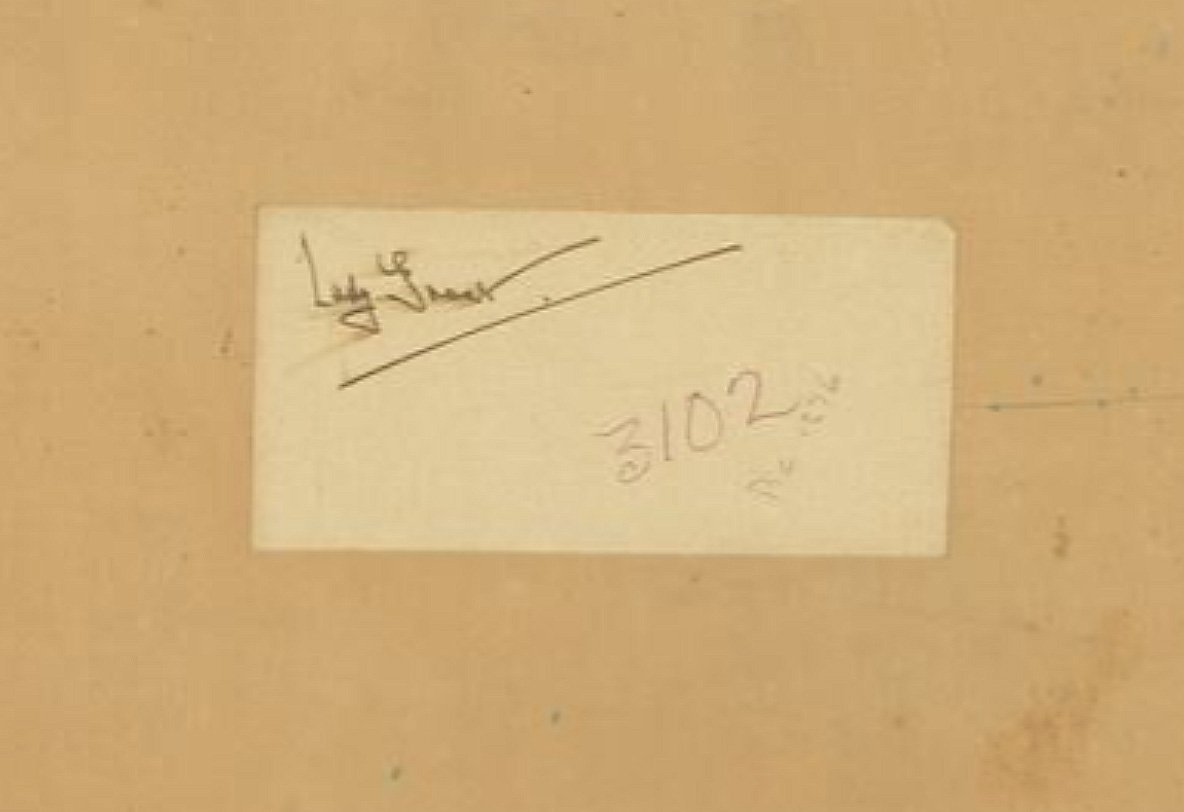
On the reverse of the painting above is a label marked “Lady Grant”. Image: IWM ART 3102
We have yet to find a catalogue for the exhibition but, piece by piece, using newspaper reports, we are building up an idea of what was on show. The Daily Mirror of 15 September 1919 reports:
The exhibition is a summary of the history of the airship from 1784 to the present day. It has a model of the Spencer 1 engine, which flew over london in 1901, and a fine anticipatory study of the New York-London service of the future. These is also the framework of Santos Dumont’s first successful machine.
The Sheffield Daily Telegraph of 15 September gives us more insight into another of the exhibits:
A wall chart shows that from June 1917 to October 1918, on anti-submarine work, 56 British airships carried out 9,059 patrols lasting 59,703 hours and covering 1,496,006 miles.
Of Lady Sybil in The World of 20 September 1919:
On Sunday she was to be found, clad in black satin raiment and flowing veil, standing amongst packing cases, dummy bombs and model airships only yet half rigged up, whilst the sound of hammers was everywhere. Nothing daunted by the alarming unpreparedness, Lady Sybil looked forward to a successful three weeks’ show with calm imperturbability very reminiscent of her father, the Earl of Rosebery.
From the Aberdeen Press and Journal of 15 September 1919…
Scotland is much to the fore in the exhibition, and two Scottish girls engaged in airship work are to give some practical demonstrations. One section is very properly historical. The ship in which Santos Dumont went up, for example, gives the layman a good line for realising the extent of airship development as represented, say, by the model of R33, which is already here, or R34, now on its way from Beardmore. With these, again, compare the model of the liner designed, by Airships Limited, to carry some 400 passengers, or the hospital ship of the future, of which a picture, at least, is shown, with the ship attached in the air to the patent past of Messers Vickers, whereby the cases can be transferred from the ship down a lift to the hospital buildings from which the mast rises. Besides the historical development the commercial possibilities of the airship are comprehensively represented. An attempt has been made which, I believe, has been practically succcessful, to get some contribution from every firm or works engaged in airship construction or construction of the parts. The number of these will be a revelation to most people. The pictorial part of the show must not go unmentioned, and especially noteworthy are several skilfully brushed backgrounds by Miss Jenny Campbell against which small model airships are swung very effectively.
We get more detail of Jenny Campbell’s backdrops from the Morning Post of 15 September 1919…
One represents most truthfully a splendid Arctic landscape, another a romantic view of the Western islands of Scotland, and the third a stretch of desert sand with the natives running away in terror at the sight of the airship hovering high above them like a thing of doom.
The Queen of 4 October 1919 reports:
The silvery models of airships are seen in their homes amidst the clouds. exquisitely reproduced. A series of cloud photographs again has its scientific as well as its artistic appeal, for they illustrate the classification now authoritatively adopted. The artistic side is further reinforced by a fine collection of drawings and paintings of which Capt. A. E. Cooper, Lieut Durant [Durrant, the wireless operator of R.34?], Edmund Dulac, and Algernon Black contribute in characteristically charming fashion. And what a vista of beauties is opened up before the artist in the air!
The technical side of the exhibition is rich in interest, too, and there are actual trophies of the war which bring their own thrill with them, including the parachute in which Brigadier-General Maitland made a descent of 10,000 feet. “He wanted to see whether the parachute would open at that altitude”! is the explanation given, with the terse comment “It did.” and example of the quaint humour which shares grim reality in more corners than one of Prince’s today.
Her efforts in putting the exhibition together didn’t come without cost. From Flight magazine of 16 October 1919:
It is with regret we hear that it has been necessary for Lady Sybil Grant’s medical advisers to order her complete rest, even to receiving no correspondence. Lady Sybil’s strenuous airship work at the Admiralty during the War, followed by her great efforts to ensure success to the Airship Exhibition at Princes’ Galleries, is no doubt responsible for the result which we hope may be of very temporary character.
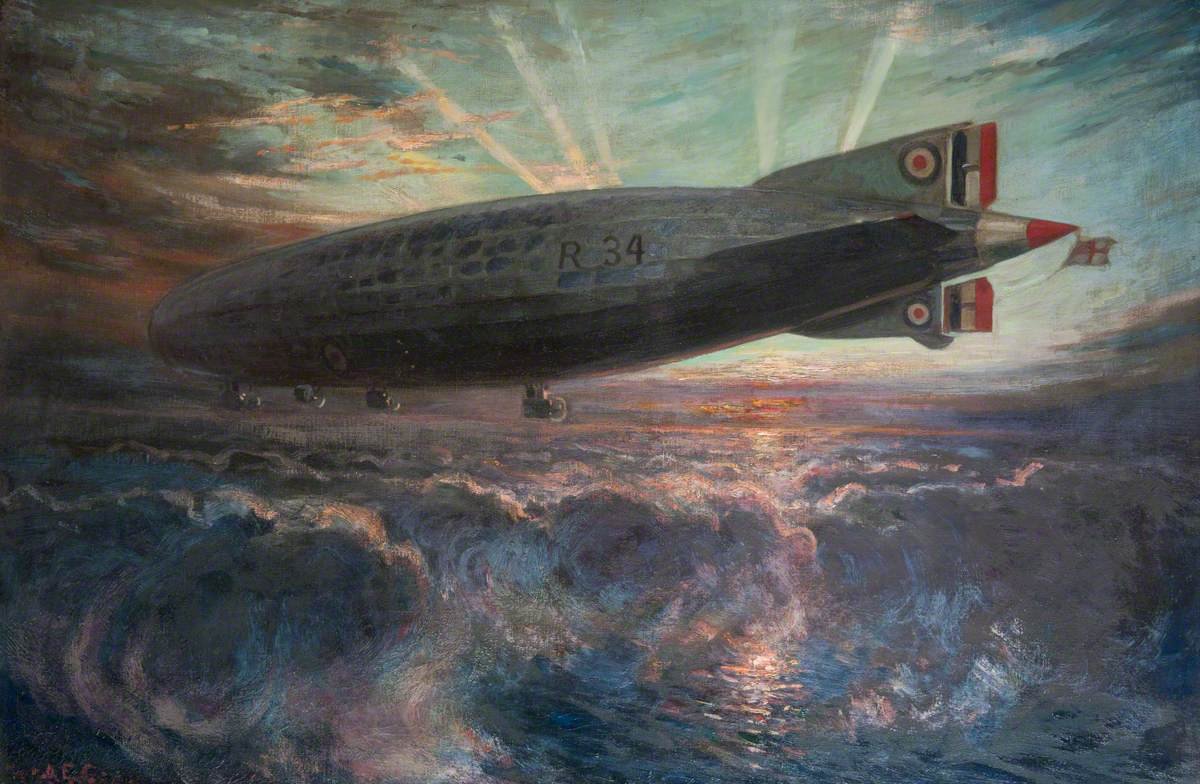
Airship R34 by Alfred Egerton Cooper. According to the Daily Express of 15 September 1919 Cooper exhibited 30 pictures at the exhibition. Image: West Dunbartonshire Libraries and Cultural Services: Clydebank Museum and Art Gallery
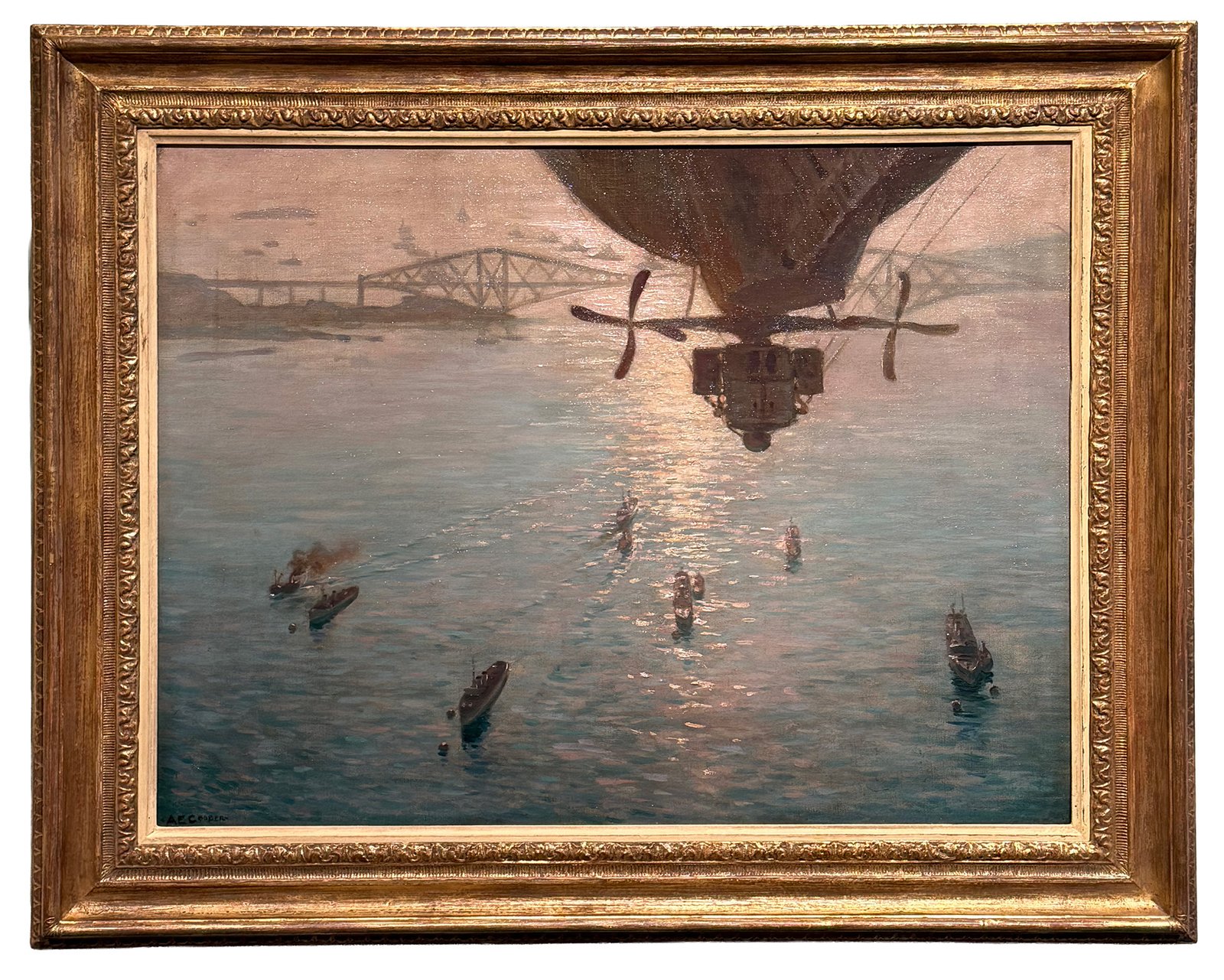
The Firth of Forth with the British Fleet, Alfred Egerton Cooper. It is believed that this painting of the rigid airship R.9 was one of the many paintings exhibited by Cooper at the Airships in Peace and War exhibition. Owned by Barnes Wallis, the painting is prominently displayed in the wall of his office in the 1955 film The Dam Busters. Repreoduced here with kind permision of Adrian Pett, Darnley Fine Art.
A FORGOTTEN VOICE OF THE AIRSHIP
Today Lady Sybil Grant remains a relatively obscure figure within mainstream aviation history. Yet her importance lies precisely in the fact that she occupied the margins between official and unofficial worlds. On the Original Narrative of R34’s Flight to America and Back July 3rd-13th, 1919 held at the National Library of Scotland, there is a typed inscription that reads:
To Lady Sybil Grant as a slight token of gratitude for the very valuable assistance she has rendered to the Airship Service, not only on this particular flight, but throughout the war.
The inscription is signed in blue ink “E.M. Maitland, Brigadier-General, R.A.F.”2
At a time when Britain debated the future of aviation, imperial air routes, and technological modernity, she acted as a persuasive advocate for lighter-than-air travel. The interwar years briefly witnessed extraordinary optimism surrounding rigid airships. Great vessels such as R100 and R101 promised a future in which passengers might drift luxuriously between continents beneath enormous silver hulls. Lady Sybil belonged to the generation that genuinely believed this future was possible.
As she grew older she became a famous writer and novelist (in 1926 publishing the “daringly outspoken” novel Riding Light under the nom-de-plume Neil Scot), ceramic designer and an artist as well as being a successful breeder of Suffolk Punch horses (a breed of draught horse), Pyrenean mountain dogs and a rare strain of dog called the Shetland Toys, which without her intervention would now be extinct.
She also became a strong advocate for the downtrodden. From her obituary in The Times of 26 February 1955:
The unconventional side of Lady Sybil Grant’s character was illustrated by her love of caravaning. This hobby brought her into touch with gypsies, with whom she had a strong sympathy, and she was the constant champion of the gypsies who were accustomed to camp on Epsom Downs during Derby week, as against the conservators of the Downs. As the châtelaine of The Durdans, her father’s famous residence, and also as herself the holder of a hawker’s licence and a van-dweller “whenever possible,” and at the same time “owner and protector of a beloved oasis between Epsom and the Downs’ she was able to help her protégés in many ways, and she instituted the Carolus prize for the best-left camping ground on the Downs, which, she said surpassed all expectations in the result achieved.
She was neither engineer nor admiral. Instead, she served as a cultural interpreter of Britain’s aviation revolution – someone who translated the strange new world of military flight into images, language, and public imagination.
Without figures like her, the history of British airships risks becoming purely technical: sheds, engines, patrol routes, and specifications. Lady Sybil restores something more human. She reminds us that the airship age was not only engineered. It was dreamed. And for a brief period during and after the Great War, Lady Sybil Grant became one of its most passionate dreamers.
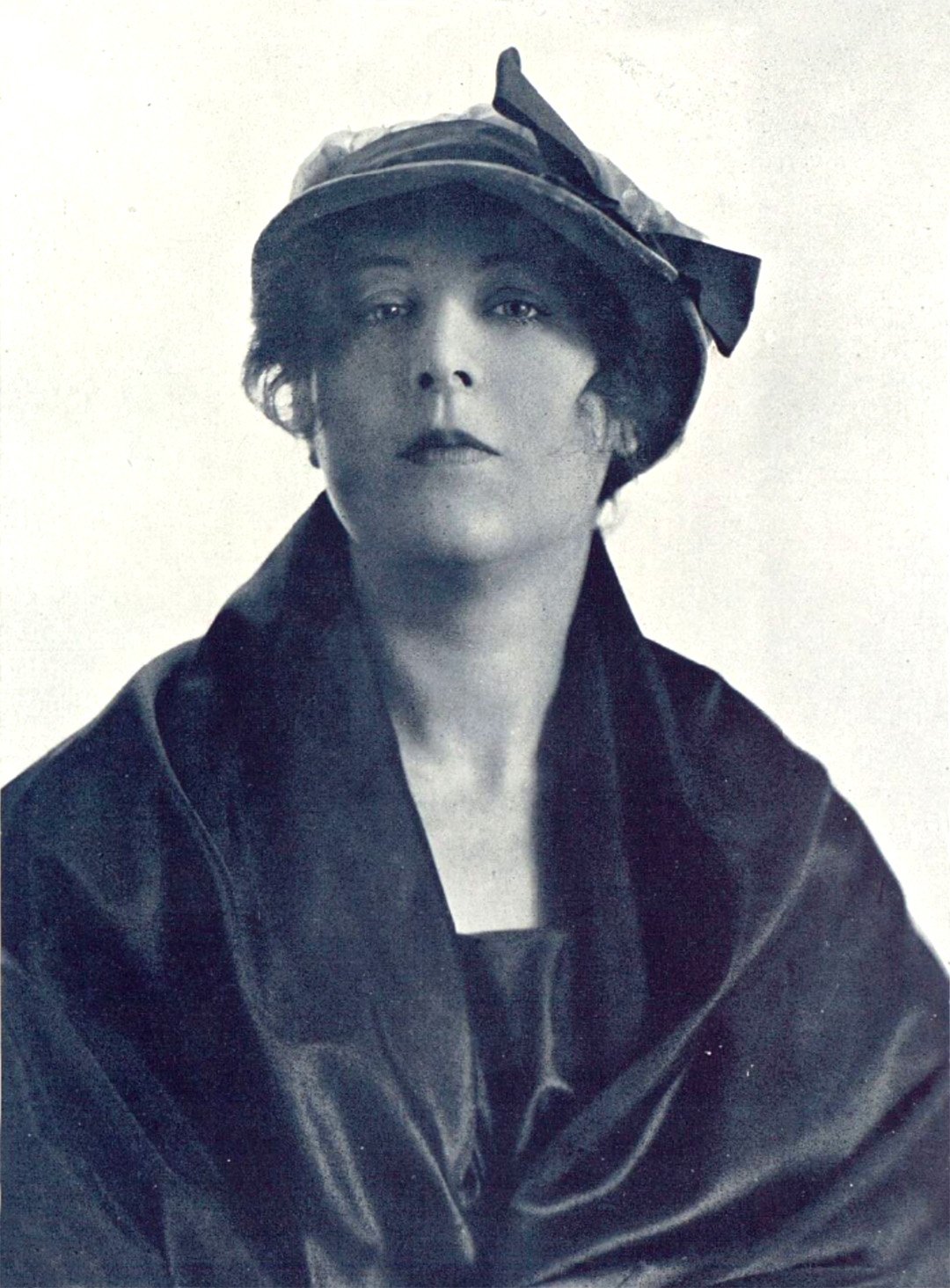
Lady Sybil Grant, The Tatler, 21 March 1917. Image: British Newspaper Archive
THE DREAM PATROL
To H.M.A. N.S.1
Nothing but darkness and the shadow of darkness.
• • • •
When the Holy Hour guards the birth of Dawn.
No first skimfooted light that shyly peeps
Across soft breasts of cloud; no hint of life,
This Holy Hour-the last sweet hour of Night.
When all the world kneels speechless, wonderful,
And with united soul keeps secret truce.
The virgin air: new woven, exquisite,
Unbreathed as yet, uncrossed by wing, untouched
(An air too pure and rare for us to know),
During this Hour is hallowed, dedicate
To all the dreams that are about to die.
The Dawn, newborn, will-all too soon-declare:
“The truce is ended”; racing hand in hand
With ruthless Day to harry Man their slave.
No living thing, till then, may urge or dare
His presence in this wondrous atmosphere.
“What is this sound like a great heart throbbing?”
Challenged the night; to whom answered straightway
The tired stars, now so soon disbanding:
“A stir as of mighty, soaring, pinions
Did bring us thronging to the edge of heaven
Lo! A stranger through the shadow climbing,
A Ship escaping-like a soul-from bondage,
Swift ascending, heard the sacred music
And so has won the freedom of the skies.”
Truly: as she climbed the cliffs of darkness,
Suddenly there rose below the stillness
Less than a song: a low, sweet, whispering,
Hushed soft as dreams: tender as caresses
(The long caress that hungers round farewell),
And the secret of this hidden music?
When night falls, and singing-birds are sleeping,
Their spirits leave them through bright spheres to stray
Just for a few ecstatic, numbered hours
Bath’e in the pools of immortality,
You: who love the fluting of the cuckoo,
Who draw enchantment from the voice of birds,
Listen once more when the sun is setting:
Here sounds no sadness at the flight of day.
Rather you notice an added sweetness.
Their task daylong to bring consolation
They reap their guerdon, in that ecstasy
Of which they must not tell when they awake.
(Yet one singing-bird there is who forfeits
Unmeasured, unimagined liberty
Just to sing of love on earth in springtime,
For his little heart is full to breaking
With the love and longing that he cannot
Express within the limits of the day.)
At length, when these liberated spirits
Return at last reluctantly to earth –
There comes a pause, just before their waking.
Whoever then hears that lovely murmur,
Divine farewell to what they must forget-
To the radiant visions they are leaving;
Differing as much from daytime singing
As fairy dancers from spruce marionettes,
To him who has the luck to overhear
There comes at once the heritage unseen,
There comes at once the freedom of the skies.
So the Ship sped; safely through the darkness
Unscathed; though it was still the Holy Hour,
And, followed by that dreamy murmuring,
Crossed sleeping country frosted thick with may
Hedges like ribbons pointing out the way
Snow-white among the shadows – all too soon
The Dawn was coming; driven from the sea.
A breeze leapt dancing like a nymph of joy
Diving and playing round the Ship; and hummed
A merry little song – the Ship herself
Named from the sea – quivered her slender length
And glittered in the sun – a thousand scents
Rushed upwards from the earth, the world awoke!
And, down below, the turmoil and the fight,
The noise that never ceases, and the wrongs,
Injustices and wrath, and pale intrigues
Spun fast their slimy webs, but all around
The silver Ship was peace; amongst the free
There is aloofness; a serenity –
Untroubled. Far above the crawling dots
That, really men, look just like angry ants,
She flew-now curving inland from the sea;
Past fevered towns whose nervous fingers clutch
Ever more land and, swollen with their wealth,
Grow uglier still from vanity – the Ship
Could see them in their just proportion small
As bee skeps – and their bloated pettiness,
So-hastening gladly, made the woods of Kent.
Here towns and factories are soon forgot j
Even the trains-like furtive lizards-hide
Quickly, as though they knew their presence must
Sin against beauty – skirt the woodlands wide,
And hurry out of sight: and oh those woods!
Trees, singly, make a separate appeal;
The plane-trees, standing with their weary feet
Blistered by paving-stones in city streets
And lifting wistful heads to find the stars.
The oak; so strong he shouts aloud for strength.
The Hex-dreaming of forgotten gods.
The silver birch that sways upon the hills,
And laughs for very joy; and lonely pines,
And brooding cedars spreading faithful wings
Around the house they love, and beeches proud,
So proud that nothing grows beneath their shade.
And holy yews, and fragrant outlaw firs
Close to whose feet the little people sit
Upon their scarlet thrones; and crusted elms
Who turn the lighter edges of their leaves
So that their aspect changes in the sun
Sudden and gentle as my father’s smile.
But woods and forests all seem holy ground
With golden depths, and long aisles leading far,
Ending as suddenly-in open space;
Perhaps a dryad’s tryst or wood-god’s lair,
Or little people’s sanctuary. Sometimes
I wonder how I ever come to dare
Wander in woods, where thousands stand on guard
To keep their secrets from me. Sudden leaves
Whirl like a signal, sudden silences
Catch at one’s heart, even the wood-doves sound
A warning note sometimes; and thick as thatch
The trees bend jealous heads and oust the sky.
Now as the shining Ship floats slowly by,
Up rise a cloud of pigeons; blue as smoke
From forest altars – such a flash of wings!
Who sent them forth in silence? Mystery
Dwells ever in the precincts of the woods.
And seen thus, from the open candid sky,
They seem to hold the secrets of the world.
Just now and then a, parting of the trees
Showed tranquil ponds – like contemplative eyes
Fringed with dark rushes – then the watchful treesAgain – and southwards to a dreaming sea
So calm the Ship seemed poising; held between
Two skies of equal, iridescent hue,
Painting their colour on her envelope.
Deep in the water where the shores retreat
The rocks and sands were clearly visible
As though to say: “Here is no mystery!”
Far off-the fretted coastal line of France;
Else, just illusion of infinity.
No living thing except some porpoises
Past Selsey Bill, in romping, careless play.
Then slowly turning on her homeward way
Regretfully she sought the land again
And through the deep, contented afternoon
Straight, purposeful as any homing bird,
Yet glorious with her new-found liberty
She journeyed heading swift and straight for home.
The western sun was playing make-believe
At forest fires, upon the port-side bow;
Some rooks; a solemn – looking black platoon
Protesting at a scarecrow; distant men
All waving at the Airship, as she swept
Unswerving through the clinging veils of dusk.
A lamp or two – not more; ’tis summer-time,
Some busy soldier camps; and then in sight
Of home, and landing, and the waiting Shed.
A moment, and she pauses; drops the Trail
And gently, silently, reluctantly
Returns from freedom and the living skies,
Caught in the toils of noisy earth again.
Yet still retains her special heritage
The new-born secret freedom of the skies
Which once the soul of man, or ship, has gained
Will keep for ever. Through this lesser life
That soul will wear a glad serenity,
Will outlive life and laugh at so-called Death;
And singing, singing, singing, reach the stars.
Lady Sybil Grant from her book of poetry The End of the Day
1. In our research we have not yet found a personal connection between Lady Sybil and Pansy. They were both from Scottish families that were very much part of the Establishment, so it is more than concievable they did know of each other at the very least.
2. Maitland was killed on 24 August 1921 when the rigid airship R38 suffered structural failure and broke up in mid air over Humber. According to airships online.com when his body was found in the wreckage, his hands were still clinging to the ballast release toggles.