
THE COXWAIN’S INQUEST
Following the loss of N.S.11 only one body was ever found – that of coxwain Charles Lewry. The inquest into his death took place at the Dun Cow, Salthouse on 31 July 1919. This detailed account of the proceedings comes from The Norfolk Chronicle of 1 August.
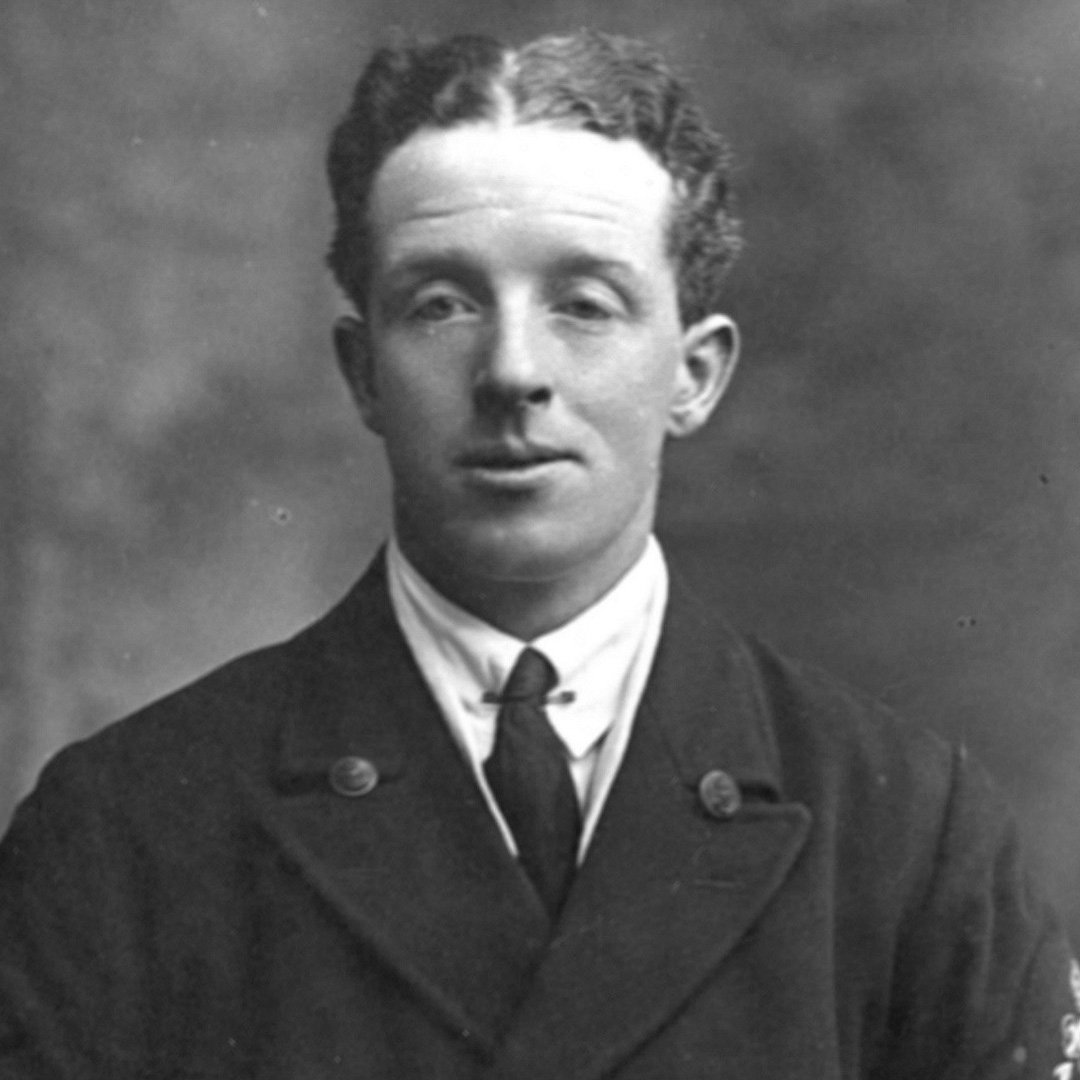
2nd Coxwain of N.S.11, Charles Lewry. Image: ns11.org
Mr H. R. Culley, Deputy-Coroner for the Duchy of Lancaster, held an inquest on the body of the airman washed up from the wrecked British airship N.S.11. which came ashore at Salthouse on Monday. Capt. Williams of the Pulham Aerodrome, from which the aircraft started on her ill-fated journey, attended, and Inspector Crane (Sherringham) represented the police. The coroner held the inquisition without a jury.
The first witness called was Thomas Walker Chandle, a sergeant in the Royal Air Force. stationed at Pulham St Mary, who gave evidence of identification. The body, he said, was that of Charles Henry Lewry, 29 years of age, a sergeant in the R.A.F., who had been stationed at Pulham. Witness last saw him alive on the 11th July at Pulham Air Station, and he had knowledge that deceased left the station the following Monday the 14th, in the airship N.S.11 on a flight, the object of which was to co-operate with the Fleet in minesweeping the North Sea. The airship never returned, and it was reported at the station that she was lost, approximately at 1.10 a.m., the next day, through fire, the origin of which was at present unknown. This occurred over sea, and the wreckage of the airship had since been recovered. Some was washed ashore and some was brought ashore by fishermen on the North Norfolk coast. Witness had viewed the body at the Rocket House on Salthouse Beach. He had examined it closely.
The coroner (to witness) : Were there any marks of burning on it? – There was one small mark on his tunic as if made from cigarette ash. There were no other marks of burning. He was dressed in his ordinary costume, which had not been burned.
Were there any marks of burning on his face or hands, or was his hair singed? – No, He doesn’t seem to have been burned at all.
Do you think he would have jumped out of the car and fallen into the sea directly fire broke out? – No, I don’t think he did.
What do you think happened then? What opinion have you formed regard to it? – I think he must have gone down with the car, and that when the car dropped into the sea he went with it.
Is there any evidence as to where the car is supposed to have dropped into the sea? Cant. Williams said there was no evidence at all.
The coroner: There was nothing in the wreckage to show that the gasbag became separated from the car? – No, but the car evidently broke up when it smashed on the water as two seats which were used by the pilots were picked up.
The witness Chandler said he was also of the opinion that the car broke up either when it hit the water or when under the water.
The Coroner: When it got to the surface would it float about for some time?
Cant. Williams: Hardly, because there were two heavy engines attached, and there was nothing to keep it up. The probability is that the whole thing would go under water at once.
Then you think the men would have been unable to get out of the car before it reached the water?
Capt. Williams: It would not be absolutely impossible. There is a small gangway which leads from the engines to the car, and if anyone happened to be on that gangway they could have jumped.
Other evidence was heard, and the verdict was returned as “Found Dead on the Beach.”
Would that apply to the whole of the crew? – Yes, perhaps, with the exception of the coxswain, who would be on duty steering. He is very much enclosed and would have great difficulty in getting out.
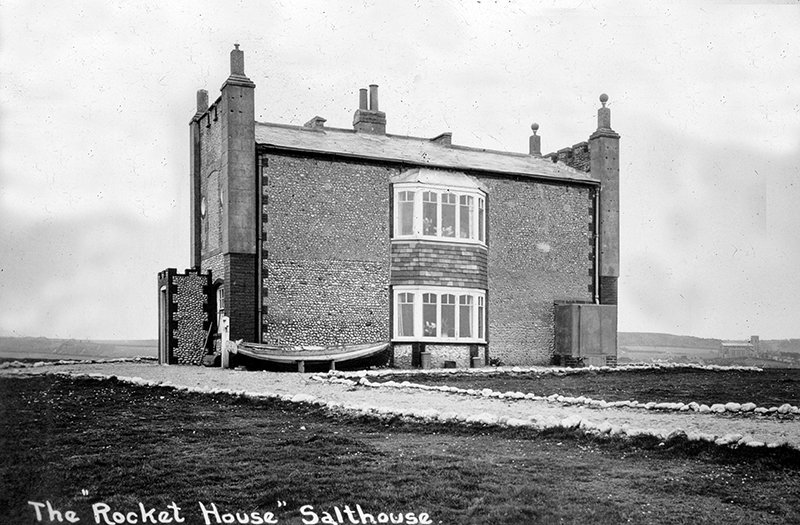
The Rocket House, Salthouse, Norfolk. Image: Wikimedia
Is the car enclosed? – yes, but there is a door and windows to it.
Asked whether when the fire broke out it would not be the object of the men to keep within the car, witness said it was constructed in very flimsy material.
Is there any evidence that the car was burned? – No, beyond the two seats which were recovered; but that may have occurred on the surface of the water. The petrol tanks which were in the envelope were burned.
The Coroner: Do the circumstances suggest that the men kept in the car to avoid the fire? – It may be, but the whole thing happened so quickly, and there is nothing to decide at that point. If anything was done at all it would have to be done at once; they would not have much time to think about it.
Do you think more than a minute elapsed between the time of the explosion and the car reaching the water? – Not much more.
So they would not have time to get out of it? – Hardly.
If they could not get out before they reached the water they would have no chance after? – Practically none.
They were released from the car by the car breaking up? – yes.
Witness Chandler: That is also my opinion.
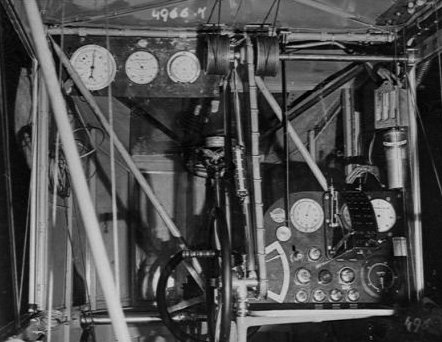
N.S.11’s cramped control station at the front of the car. The coxwain’s position was at the steering wheel forward of the instrument panel . Image: Brian Turpin
In reply to the Coroner’s question whether deceased duties would take him outside the car, witness said he was second coxswain, and according to the approximate time at which the explosion was believed to have taken place, he should have been at the wheel or about to be relieved by Coxwain Waghorn. The coxswain did not sit outside the car for the purpose of steering, but in the front part of the car. That was a most difficult part of the car to get out of and it was quite probably that deceased was in that part of the car at the time and would have lost the chance of getting out. The two seats which had been recovered were in this part of the car. It was quite probably that this part was smashed on reaching the water, and that deceased would be released in the same way as the seats. That was the only part of the car that had been found.
Capt. Williams, in answer to the Coroner, said he could see no reason for supposing that the car became separated from the envelope. Asked whether it would have been possible for the occupants of the car to have opened the door and released themselves, Capt. Williams replied in the affirmative, but pointed out that there was fire above them and an explosion had taken place. Yes, It is possible they got entangled in the first place, which possibly had stunned the thought the deceased was the only man who was released from the car, though the probabilities pointed in that direction. Still it was difficult to say as there was such scanty material upon which to form an opinion.
Do you think that the deceased was the only man released and that the others were imprisoned in the car? – That is what it looks like.
And eventually sink when the thing burned? – Yes. It is possible they got entangled in the wire rigging or the envelope.
Then in your opinion deceased fell out of the car when it met the water through the front part of the car having been broken? – Yes.
Witness Chandler informed the Coroner, in his answer to further questions, that deceased was a married man, and his home address was 144 Leesland-road, Gosport.
John Wainer, of Church House, Salthouse, second lieut. Shropshire Light Infantry (invalid), said he was on the beach at Salthouse on Monday, July 28th, about half-past 10 o’clock in the fore-noon, when he saw the body lying on the beach at high-water mark. Witness formed the opinion that the tide when receding had left it there. He sent a message to the local Coastguard and the body was removed to the Rocket House.
William Hancock, parish constable of Salthouse, gave evidence as to searching the body and finding nothing to relate to the death.
The Coroner recorded a verdict in the following terms: “Found dead on the beach, having been washed ashore from the sea in which he had fallen through an airship of which he was one of the crew having become on fire for some reason unknown.”
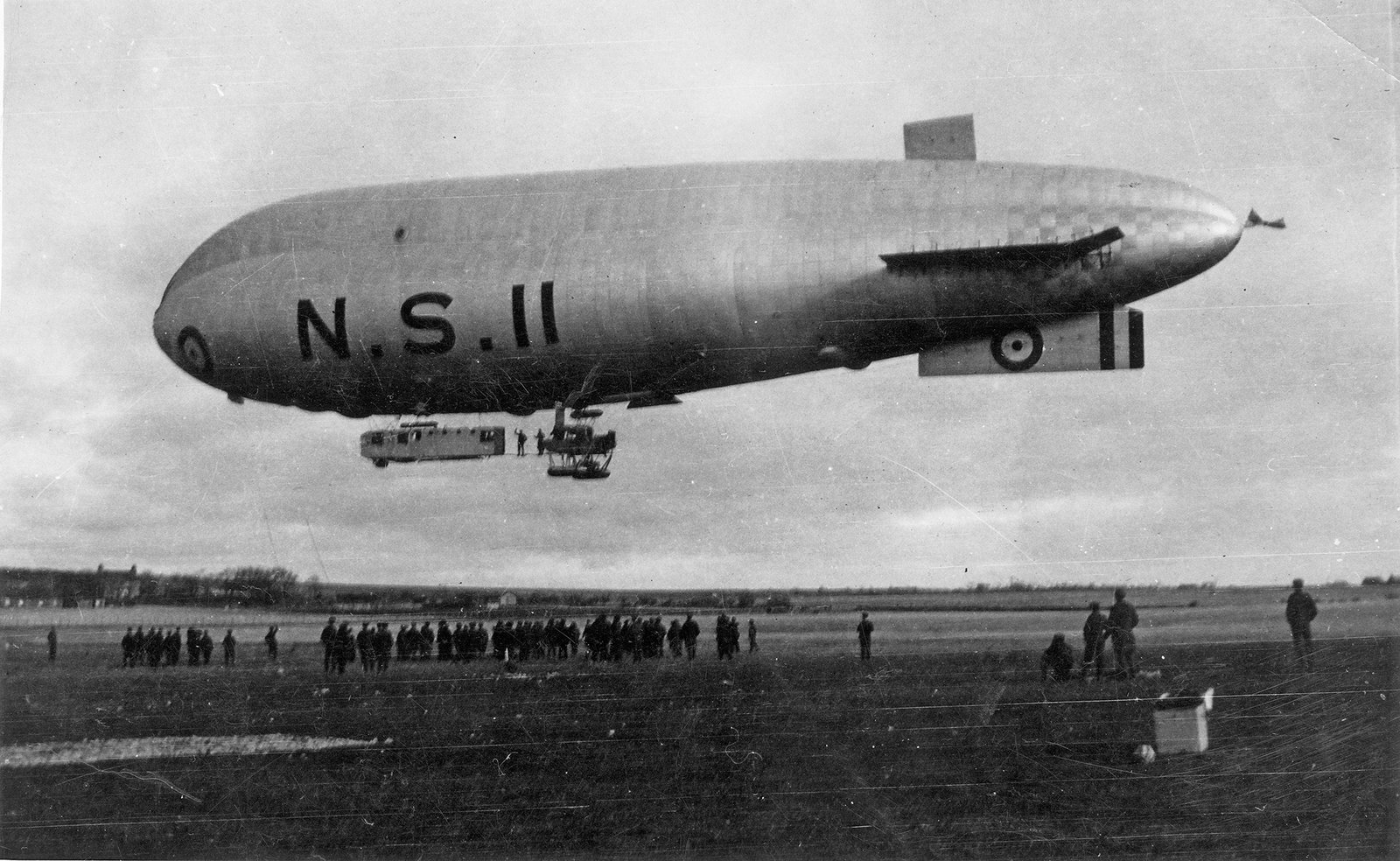
N.S.11 at Pulham. Image: NS11.org
It is a fact worthy of record that Coastguard Eade, of Morston, is a distant relative of the deceased. Of that fact, however, he had no notion when he first saw the body, the features of which were wholly unrecognisable, and he did not realise his relationship until he saw the name and address of the deceased in the newspapers.
Account from The Norfolk Chronicle, Friday 1 August 1919. British Newspaper Archive
- Actually William R Eales who was coastguard at Morston until his death in 1939.